Battery health has become one of the defining questions in the used EV market. It influences buyer confidence, vehicle valuations, warranty decisions and, increasingly, the speed at which a car sells.
As a result, battery reports are becoming commonplace. Many present a single battery health percentage, typically derived from the vehicle’s own Battery Management System (BMS). It’s an understandable approach: a simple number is easy to communicate and it invites a like-for-like comparison between one car and the next. That appeal is understandable, but in the context of EV battery health it can be misleadingly incomplete.
A battery is not a simple component, and battery health is not a simple question.
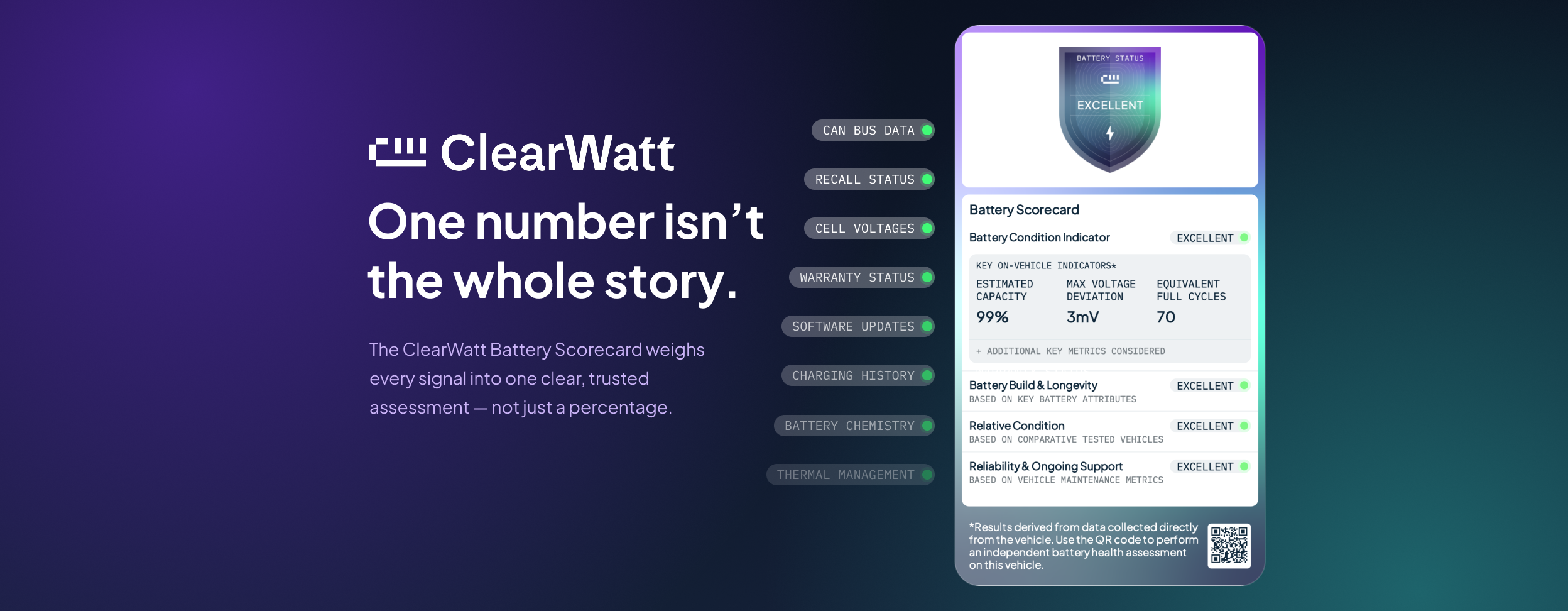
At ClearWatt, we’ve taken a different approach. Rather than reducing battery condition to a single measurement, we’ve developed the Battery Scorecard: a unified framework that combines the strongest evidence available for each vehicle into one consistent assessment of battery condition.
Whether that assessment comes from a two-minute plug-in test on the forecourt, an app-based battery check, a charging assessment or ongoing connected vehicle monitoring, the aim is always the same: to provide the clearest possible understanding of the battery using the evidence available.
A better question
When somebody asks whether an EV battery is healthy, a single percentage is often an unreliable answer. Because each manufacturer calculates State of Health using its own undisclosed method, the same figure can describe very different batteries - and independent testing shows BMS-reported values sometimes fail to track a battery’s real capacity at all.
The question prospective EV buyers are really asking is whether the battery is performing as expected today, how it is likely to hold up in the years ahead, and whether anything deserves closer attention.
Answering those questions requires judgement as well as data.
Imagine two otherwise identical vehicles.
Both report ‘94%’ State of Health from their Battery Management System.
On one vehicle, every other indicator points towards a battery that is ageing exactly as expected. On the other, additional evidence suggests behaviour that deserves further investigation.
This is not hypothetical. An independent 2026 study of 1,114 EVs across five manufacturers found real capacity differences of 12–25% within every single model, yet the batteries’ own BMS-reported figures frequently failed to reflect them - meaning the same headline number can conceal very different states of health.
Should those two batteries really receive exactly the same assessment?
We don’t believe they should.
One number is valuable. It just isn’t the whole story.
Modern EVs monitor their batteries continuously through sophisticated Battery Management Systems. Depending on the manufacturer, these systems may estimate State of Health, remaining usable capacity and other diagnostic information.
In some cases, third-party tools calculate an SoH-style percentage from a BMS-derived usable capacity figure, but this remains a manufacturer-derived estimate rather than an independent measurement of battery condition.
Where these values are available, ClearWatt uses them.
They are an important piece of evidence and often provide valuable insight into how the vehicle itself understands the battery.
However, manufacturers calculate and expose this information in different ways. The data available varies from vehicle to vehicle, and a single value cannot describe every aspect of battery condition. It tells part of the story, but rarely all of it.
That is why the Battery Scorecard is designed to consider a much broader evidence base.
Built from the widest possible evidence
No single test can reveal everything about an EV battery.
Some assessment methods have access to detailed diagnostic information directly from the vehicle. Others provide insight through real-world driving, charging behaviour or long-term connected vehicle data. Each contributes different evidence.
The Battery Scorecard is designed to bring those sources together into one consistent assessment.
Depending on the vehicle and the assessment method, the Scorecard may consider:
- Manufacturer-derived battery information, including State of Health or estimated usable capacity where available.
- Battery diagnostics, including cell balance, voltage behaviour and other technical indicators.
- Battery usage, including age, mileage and equivalent full charge cycles where available.
- Charging behaviour and battery performance data, where available.
- Real-world driving and charging assessments.
- Vehicle-specific expectations based on battery chemistry, pack architecture and model characteristics.
- ClearWatt’s benchmarking across comparable vehicles and our growing real-world EV dataset.
- Software and over-the-air (OTA) update status, which can change how the battery is managed and charged.
- Outstanding recall and manufacturer campaign status affecting the battery or its management system.
- Warranty status, including remaining battery warranty cover and any manufacturer State of Health thresholds that apply.
Not every assessment has access to every one of these inputs, nor should it.
Instead, the Battery Scorecard uses the richest evidence available for that vehicle, interpreting each signal according to its relevance and reliability before combining them into one clear assessment.
One Battery Scorecard. Multiple ways to assess a battery.
One of the principles behind the Battery Scorecard is consistency.
Different situations call for different assessment methods.
A retailer appraising stock on the forecourt may need an answer in minutes. A private owner may prefer a hardware-free assessment from home. A workshop investigating a specific concern may carry out a detailed OBD diagnostic. Some EV specialists choose to combine multiple ClearWatt assessment methods, such as our OBD and Charging Tests, to build an even richer picture of battery condition where the additional evidence is valuable.
Each approach has different strengths.
Rather than producing different definitions of battery health, every ClearWatt assessment feeds into the same Battery Scorecard framework. That means retailers, consumers and fleet operators all receive a consistent way of understanding battery condition, regardless of how the evidence has been gathered.
As new technologies and new sources of vehicle data emerge, the framework can evolve alongside them without changing the way battery health is communicated.
Raising the standard for used EV battery assessment
The used EV market is maturing rapidly, and expectations are changing with it.
“EV buyers have evolved from early adopters into the majority. These new customers need reassurance about the battery health beyond a bare number (they like a descriptor like excellent/good) and they need to understand how this impacts range. ClearWatt data and certificates give this information clearly and simply.” Estelle Miller, EV Experts
Customers increasingly expect evidence rather than reassurance. Retailers want assessments they can confidently stand behind. Fleet operators need battery information they can apply consistently across thousands of vehicles.
Meeting those expectations requires more than reproducing a single data field from a vehicle.
It requires gathering the broadest relevant evidence available, interpreting that evidence intelligently and presenting it in a way that is clear, consistent and easy to understand.
That is the thinking behind the ClearWatt Battery Scorecard.
Manufacturer-derived battery health values remain an important part of our assessments whenever they are available. We simply believe they are strongest when considered alongside the wider evidence.
Because when someone asks whether an EV battery is healthy, they’re not really asking for a number.
They’re asking whether they can trust the car.
The Battery Scorecard is our answer to that question.
Share this article