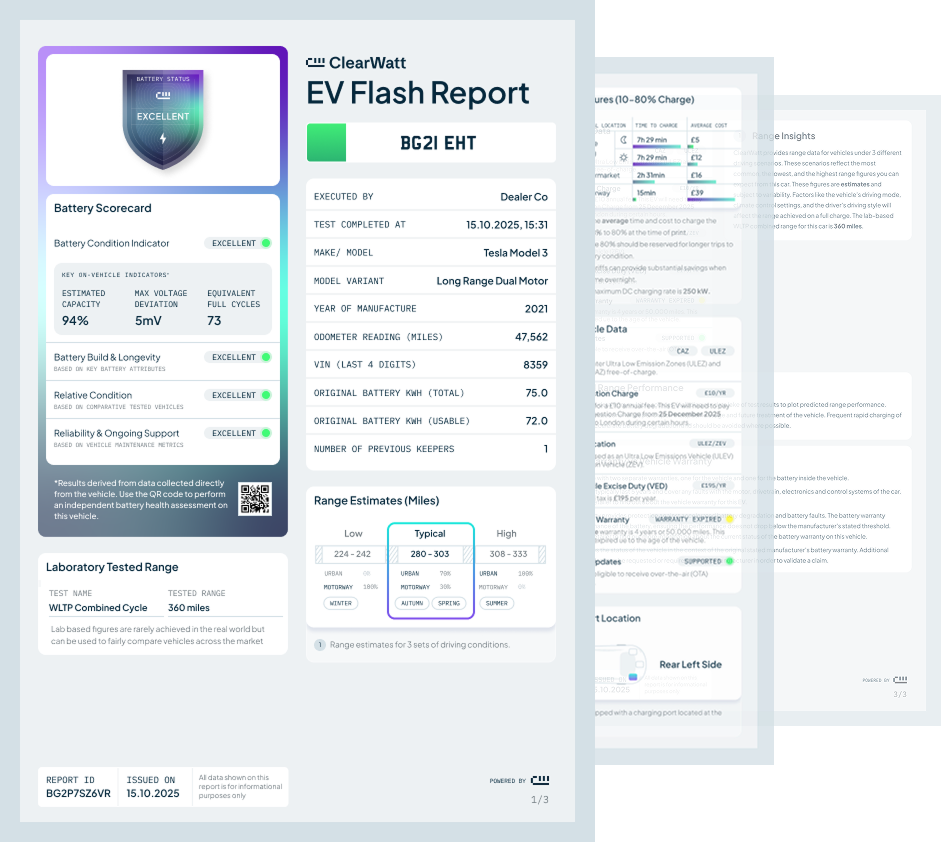
Buying a used electric vehicle should not feel like a leap of faith.
The ClearWatt EV Flash Test is designed to give buyers a clearer picture of how an EV battery is performing today, using a combination of live data from the vehicle itself and real-world EV performance insights from ClearWatt’s wider database.
In simple terms, it helps answer the questions most buyers care about:
- Is the battery performing well?
- Are there any warning signs beneath the surface?
- What kind of real-world range can I realistically expect?
- What does this mean for everyday ownership?
What is the EV Flash Test?
The EV Flash Test is a battery health assessment carried out using an OBD diagnostic device connected to the car. This allows us to read information directly from the vehicle’s own systems, including the battery management system and other onboard control units.
That matters because we are not just making a rough estimate based on age or mileage. We are looking at what the vehicle itself is telling us about the battery and its condition.
Rather than relying on one headline figure alone, we assess a wide set of battery-related signals to build a more complete picture of battery health.
Where does the data come from?
The EV Flash Test uses two main sources of information.
1. Data read directly from the vehicle
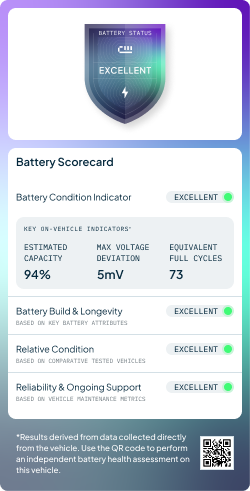
This is the most important part of the test, because it tells us what is happening inside that specific vehicle at the point of inspection.
2. ClearWatt real-world performance data
Other parts of the report, such as real-world range guidance, charging expectations and some ownership insights, are supported by ClearWatt’s wider EV data. That dataset is built from real-world vehicle performance insights gathered through ClearWatt’s EV Copilot ecosystem.
This helps us go beyond lab-based figures and show buyers information that is more useful in everyday driving.
What are we actually looking for?
At a high level, we are looking at how well the battery appears to be holding up, how evenly it is performing, and whether there are any signs that deserve closer attention.
That includes things such as:
- overall battery condition
- evidence of energy retention
- how the battery has been used and charged
- battery chemistry and pack design factors
- whether the vehicle’s battery behaviour looks consistent with what we would expect
We do not reduce the test to a single simple reading, because battery health is not really one thing. It is a combination of condition, consistency, behaviour and context.
Why battery cell voltage matters so much
One of the most important parts of the EV Flash Test is our inspection of battery cell voltage data.
An EV battery pack is made up of many individual cells working together. For the pack to perform well, those cells need to stay closely aligned. In a healthy battery, the cells usually sit very near one another in voltage terms. Small differences are normal. Larger gaps can be a sign that parts of the pack are no longer behaving as evenly as they should.
That matters because cell imbalance can affect more than just a technical reading on a screen. It can influence:
- how much of the battery’s energy is truly usable
- how consistently the car charges and discharges
- how stable performance feels over time
- how well the pack is ageing as a whole
A battery can sometimes look acceptable from a single headline number alone, but cell-level inspection can reveal a more detailed story underneath. That is why voltage deviation is such an important part of a serious battery health check.
Put simply: we are not only asking “how much battery is left?” We are also asking “how healthy and balanced is the pack underneath?”
What does the report show a buyer?
The report is designed to turn detailed technical analysis into something a buyer can actually use.
Depending on the vehicle, it can help explain:
- the overall battery condition
- estimated battery capacity or condition indicators
- battery cell voltage deviation
- expected real-world range
- predicted range performance over time
- charging compatibility and expected charging figures
- battery warranty status and other useful ownership information
Why this matters for used EV buyers
For most buyers, the battery is the single biggest question mark when considering a used EV.
Petrol and diesel buyers have long been able to judge a car by service history, mileage, condition and how it drives. With an EV, battery condition becomes one of the most important extra pieces of the puzzle.
A strong battery assessment can give buyers more confidence that:
- the car is performing as it should
- the pack appears healthy and well balanced
- the likely real-world driving experience matches expectations
- they are making a better-informed purchase decision
It also helps move the conversation away from myths and guesswork and towards actual vehicle data.
A more complete picture than a single number
One of the biggest misunderstandings in the used EV market is the idea that battery health can be captured perfectly by one percentage alone.
In reality, meaningful battery assessment is broader than that.
That is why the ClearWatt EV Flash Test takes a more holistic approach. We combine detailed on-vehicle analysis with real-world performance insight to give buyers a clearer, more practical view of the vehicle in front of them.
Important to understand
The EV Flash Test is a snapshot of battery condition at the time of testing. It is designed to provide a detailed and informed assessment, but like any inspection, it reflects the vehicle as tested on that day.
That is why it works best as part of an overall used-EV buying decision: giving buyers better information, more transparency and greater confidence.